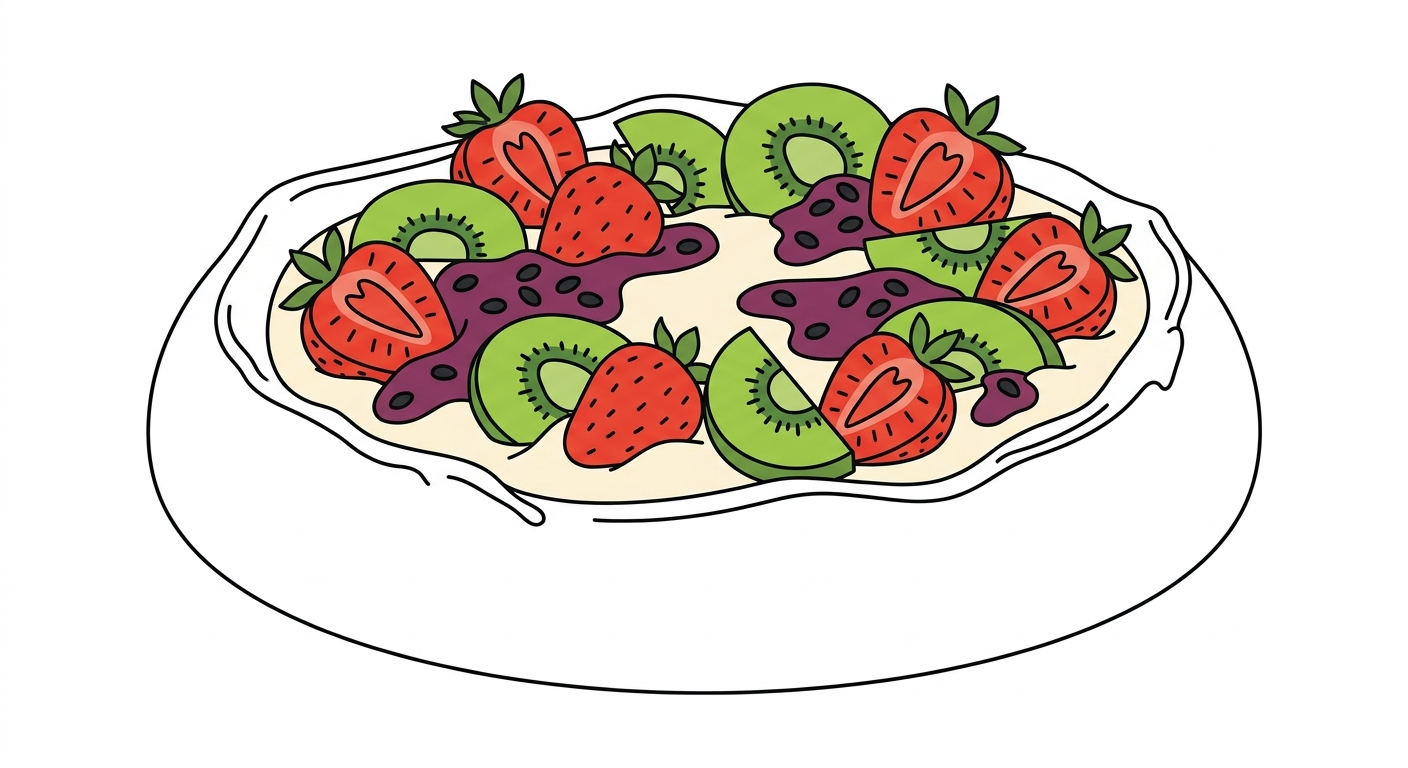
Pavlova is a meringue — egg whites beaten with sugar until stiff, folded with cornstarch and vinegar, baked low and slow until the outside forms a thin, papery crust and the interior stays soft and marshmallowy, then topped with whipped cream and fresh fruit. The cornstarch is what distinguishes it from a French meringue, which is dry and crisp all the way through. The pavlova interior is deliberately yielding — almost sticky, with a chew that collapses gently rather than shattering. The fruit on top is typically kiwi, strawberry, or passionfruit, the acidity cutting through the sweetness of the meringue and cream in a combination that is more considered than it looks. It is a summer dessert, associated in both Australia and New Zealand with Christmas, warm weather, and tables set outside.
The name comes from Anna Pavlova, the Russian prima ballerina who toured Australia and New Zealand in 1926 to enormous public enthusiasm. Naming dishes after celebrated visitors was common practice in the early 20th century — peach Melba honored Australian soprano Nellie Melba at London’s Savoy, and pavlova followed the same logic. The meringue dessert was associated with the ballerina’s lightness, its white cloud of cream and crisp exterior understood as a visual reference to her tutu and her dancing. Whether the dessert was created specifically for her visit or simply named for her afterward is one of the questions that neither Australia nor New Zealand has been able to resolve definitively.
The origin dispute is one of the more entertainingly documented culinary controversies in the English-speaking world. New Zealand’s case rests on evidence: the earliest documented recipe resembling modern pavlova appears in the 1929 New Zealand Dairy Exporter Annual, followed by the 1933 Rangiora Mothers’ Union Cookery Book. Food historian Helen Leach of the University of Otago documented 21 New Zealand cookbook recipes for pavlova before Australia’s first appeared in 1935 — that recipe attributed to Bert Sachse, chef at Perth’s Esplanade Hotel, who claimed to have created the dessert for the afternoon tea menu. New Zealand has the earlier documentation. Australia has Bert Sachse. Both countries have strong feelings about the matter that show no sign of resolving.
The deeper history, as researchers Andrew Paul Wood and Annabelle Utrecht established, runs through neither country. The meringue cake topped with cream and fruit descends from the Austro-Hungarian Spanische Windtorte — an elaborate Viennese meringue confection — which traveled to the United States through German-speaking immigrant communities, where it became known as Schaumtorte or Baisertorte. American cornstarch manufacturers, who discovered that adding cornstarch to meringue produced a softer interior, began printing the recipe on their packaging and exporting the product to New Zealand in the 1890s. The distinctive marshmallow center that defines pavlova — and distinguishes it from European meringue — is almost certainly an American cornstarch company’s contribution, which means the dessert that Australia and New Zealand fight over most vigorously arrived in both countries on the back of an American box.
None of this diminishes what pavlova has become in the Antipodean context. It is genuinely central to the food culture of both countries — present at Christmas tables, at summer celebrations, at any gathering significant enough to warrant a dessert that requires some effort and looks impressive when it works. When it doesn’t work — a collapsed center, a weeping meringue, cream that won’t hold — the failure is social as much as culinary, and anyone who has made a pavlova for a crowd understands the particular anxiety of the hour before serving. The dessert that sparked an international rivalry is also, in practice, one of the more reliably dramatic baking projects available to home cooks. That combination of spectacle and risk is probably part of what made it worth arguing about in the first place.
This content was created with the assistance of AI. Sources are currently being reviewed.