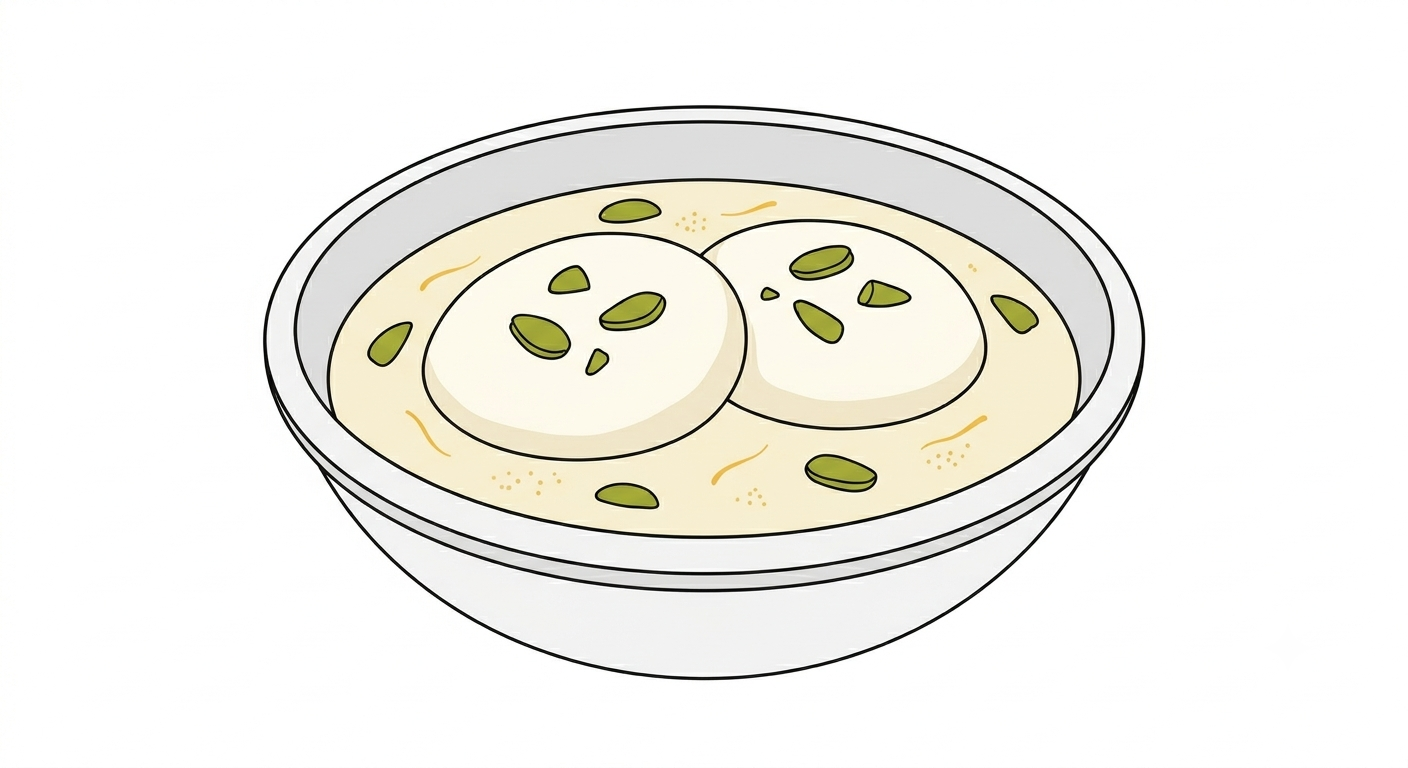
Ras Malai consists of small flattened discs of chenna — fresh cheese made by curdling hot milk with an acid and draining the whey — cooked in sugar syrup until they puff and soften, then transferred into chilled, thickened milk seasoned with cardamom, saffron, and rose water. The discs absorb the milk as they sit, becoming soft enough to cut with a spoon. The dish is served cold, in a shallow bowl with the milk poured over, garnished with pistachios or almonds. The name translates roughly to “juice of cream” — ras meaning juice or essence, malai meaning cream.
The texture of good ras malai is the central technical challenge. The chenna must be kneaded thoroughly before shaping — undermixed chenna produces grainy, crumbly dumplings that fall apart in the syrup. The cooking liquid must be kept at a controlled simmer; boiling causes the dumplings to tighten and toughen. The thickened milk, called rabri or a simplified version of it, is reduced slowly and must be cooled completely before the cooked dumplings are added. The full dish requires time and attention across multiple stages.
Ras malai belongs to the Bengali sweet-making tradition, which centers on chenna-based confections — a category that distinguishes Bengal from much of the rest of the Indian subcontinent, where milk sweets more commonly use khoa, a dry-cooked reduced milk solid. The use of chenna in Bengali sweets is documented from at least the nineteenth century, and Kolkata and Dhaka are both claimed as points of origin for ras malai specifically. The dessert is associated with Bengal broadly and is made and eaten across both West Bengal and Bangladesh, where it is a standard at celebrations and religious occasions.
The origin of chenna-based sweets in Bengal is sometimes attributed to Portuguese contact in the sixteenth and seventeenth centuries — Portuguese traders and settlers in Bengal made fresh cheese, and the technique of curdling milk with acid may have entered Bengali cooking through that exchange. This is debated among food historians; some argue that the technique developed independently. The Portuguese influence theory is plausible for chenna as an ingredient but does not extend directly to ras malai as a preparation, which is a distinctly Bengali development in form and flavor.
Ras malai is widely available across South Asia and in South Asian diaspora communities internationally. Commercial versions are sold refrigerated in sealed containers and are a common supermarket item in areas with large South Asian populations. These vary considerably from fresh versions made to order; the dumplings in packaged ras malai are typically denser and the milk thinner. Fresh ras malai from a Bengali sweets shop — mithai shops that specialize in the tradition — is a different product.
This content was created with the assistance of AI. Sources are currently being reviewed.