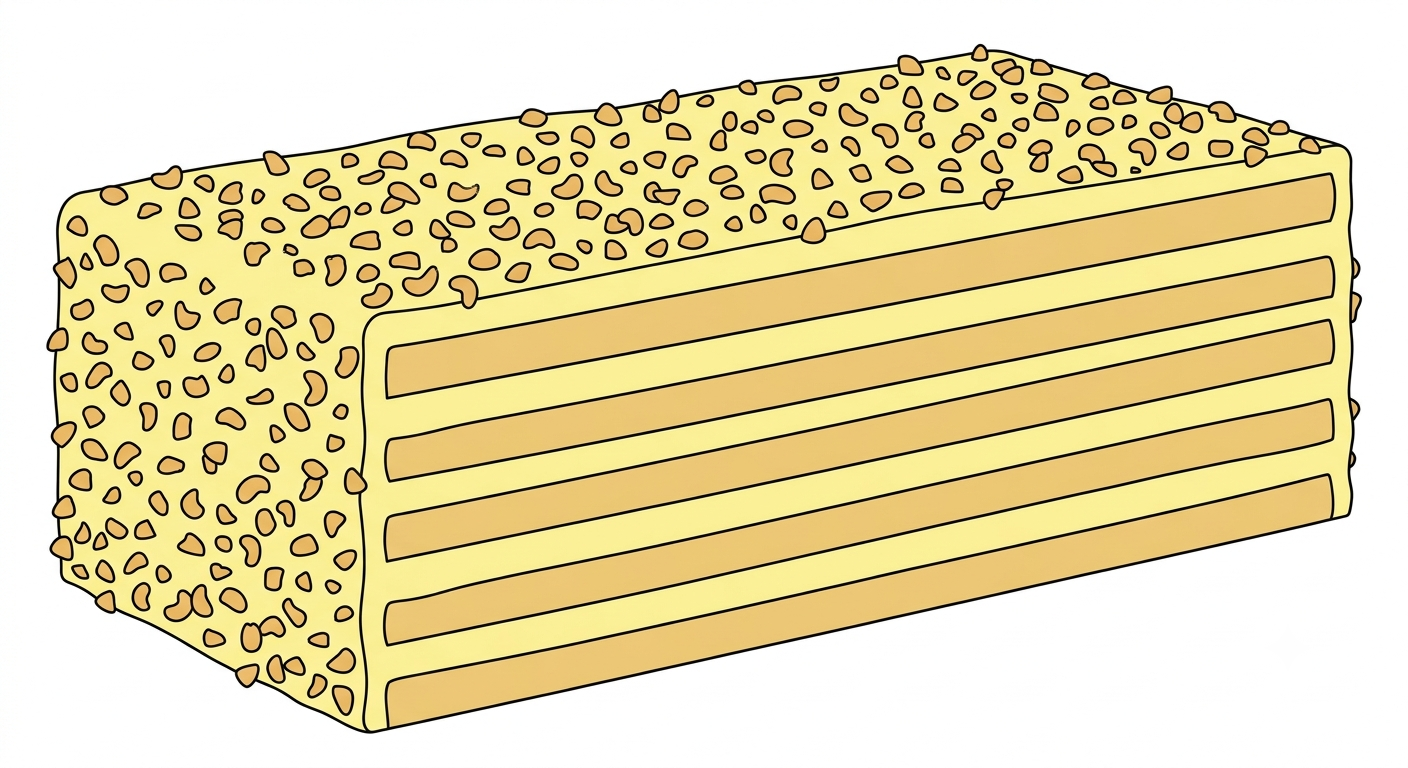
Sans rival is a layered cake — crisp cashew meringue discs stacked with French buttercream, finished with more chopped cashews on top and sides. The name is French for “without rival,” which Filipinos who have grown up eating it will not dispute. The meringue layers are thin, crunchy at the edges, slightly chewy in the center, and heavily studded with cashew pieces. The buttercream is rich and not particularly sweet. The combination of textures — brittle, chewy, and fatty all at once — is the thing that makes it specific. It does not taste like anything else.
The origin story is fairly consistent across sources. In the 1920s and 1930s, a generation of Filipinos went abroad to study, a significant number of them to France. They came back with French cooking techniques, among them the dacquoise — a meringue cake made with ground nuts, layered with buttercream, a specialty of the town of Dax in southwestern France. The substitution that defined the Filipino version was the cashew. Hazelnuts and almonds, standard in the French original, were not what was available in the Philippines. Cashews were. The swap changed the flavor profile completely — cashews are milder, sweeter, more buttery than either hazelnut or almond — and the result was distinct enough from its source material that it became its own thing.
A competing origin theory links it to the Spanish tarta imperial rusa, itself an adaptation of a Russian cake popular with the Romanovs, which traveled to the Philippines through the layers of Spanish colonial influence. The shared structure — meringue, cream, nuts — makes both theories plausible, and the honest answer is that the documented history of sans rival is thin enough that neither can be definitively confirmed.
What is not in dispute is where the cake landed. Dumaguete, in Negros Oriental, became its capital — the city most associated with sans rival production, home to the bakeries that made it famous and the source from which it spread across the Philippines. Sans rival from Dumaguete is the standard against which other versions are measured, in the same way that pastel de nata from Belém is the original against which every other version is compared. The association is geographic, specific, and taken seriously.
A smaller, cookie-sized version called silvana — the same cashew meringue and French buttercream combination, rolled in cookie crumbs — exists alongside it and has its own following. The sans rival is the formal version, cut into rectangular slices for celebration tables. The silvana is what you eat standing up. Both are correct applications of the same idea, and both have traveled with the Filipino diaspora to the United States, the Middle East, and beyond, where they are made in home kitchens and sold in Filipino bakeries as markers of a specific taste of home.
This content was created with the assistance of AI. Sources are currently being reviewed.