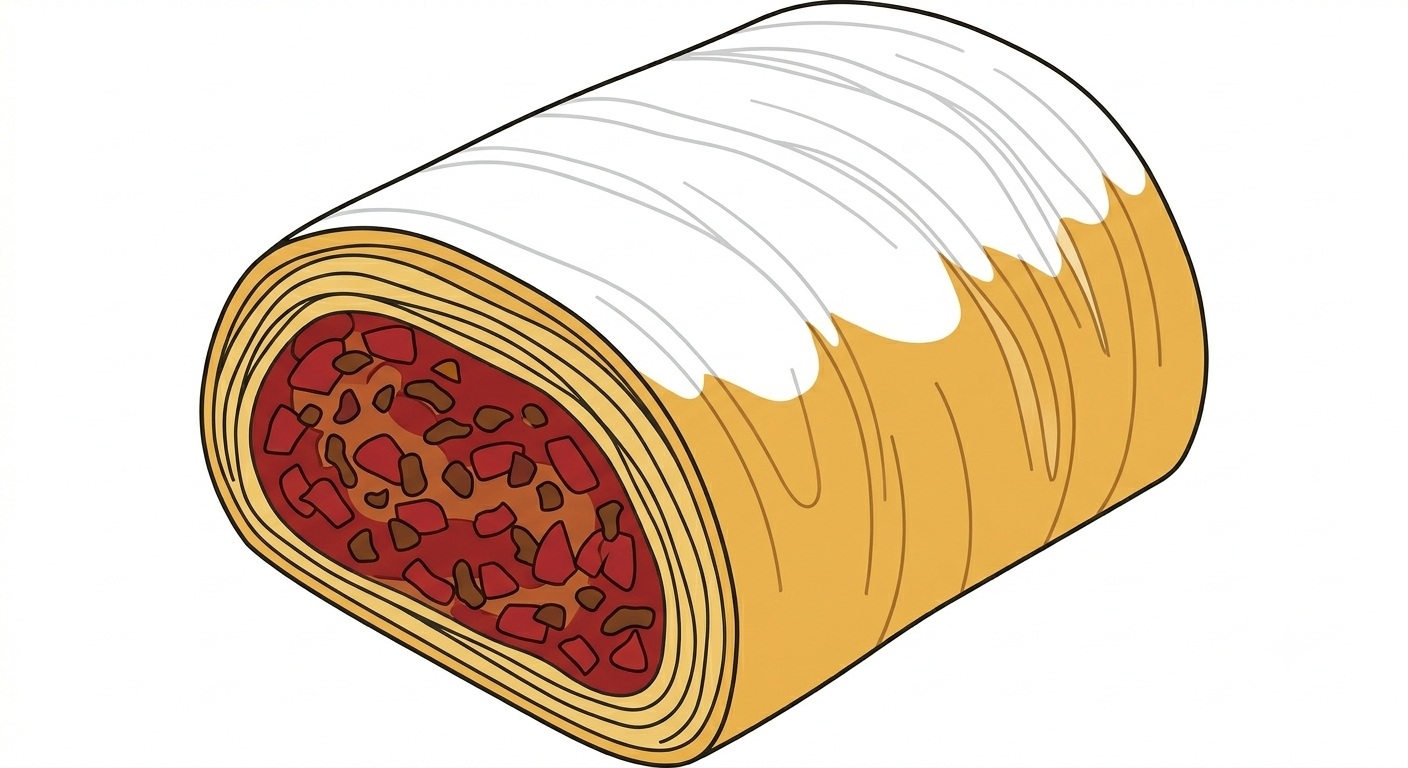
Strudel in the northern Italian regions of Alto Adige and Trentino is a tightly rolled pastry made from an unleavened dough stretched to near-transparency, filled with thinly sliced apples, raisins, pine nuts, cinnamon, and breadcrumbs, then baked until the outside is golden and the filling has collapsed into a dense, fragrant, jammy core. It is sliced into rounds and served warm, sometimes with a dusting of powdered sugar, sometimes with a spoonful of cream alongside. The dough is the technical challenge — it must be stretched by hand over a floured cloth until it is thin enough to read through without tearing, a skill that takes time to develop and is immediately apparent in the result.
The strudel of Alto Adige is not the same object as the Viennese apfelstrudel it descends from, though the technique and the filling are closely related. Alto Adige — also known as Südtirol, South Tyrol — was part of the Habsburg Empire until 1919, when it was ceded to Italy following World War I. The region is culturally and linguistically German-speaking in large part, and its food reflects centuries of Austrian and Tyrolean influence more than Italian. Strudel arrived with that culture and stayed, adapting slightly to local ingredients — the apples of the Val Venosta valley, in particular, are among the finest in Europe and are central to why the Alto Adige version has its own distinct reputation.
The word strudel means “whirlpool” or “eddy” in German, a reference to the spiral of filling visible when the pastry is sliced. The technique of stretching dough paper-thin before rolling it around a filling has roots that extend beyond Austria — phyllo pastry in the Ottoman and Greek tradition operates on the same principle, and the connection between Viennese strudel and the baklava-adjacent pastries of the eastern Mediterranean is well established historically, traveling westward through the Balkans and into the Habsburg kitchen over centuries of contact and trade.
In Alto Adige today, strudel is as embedded in local identity as any specifically Italian pastry elsewhere in the country. It appears in farmhouse kitchens, in mountain huts, in bakeries alongside pumpernickel and rye bread, and on restaurant menus that reflect a food culture that has always been more Central European than Mediterranean. It is Italian by geography and Tyrolean by everything else.
This content was created with the assistance of AI. Sources are currently being reviewed.