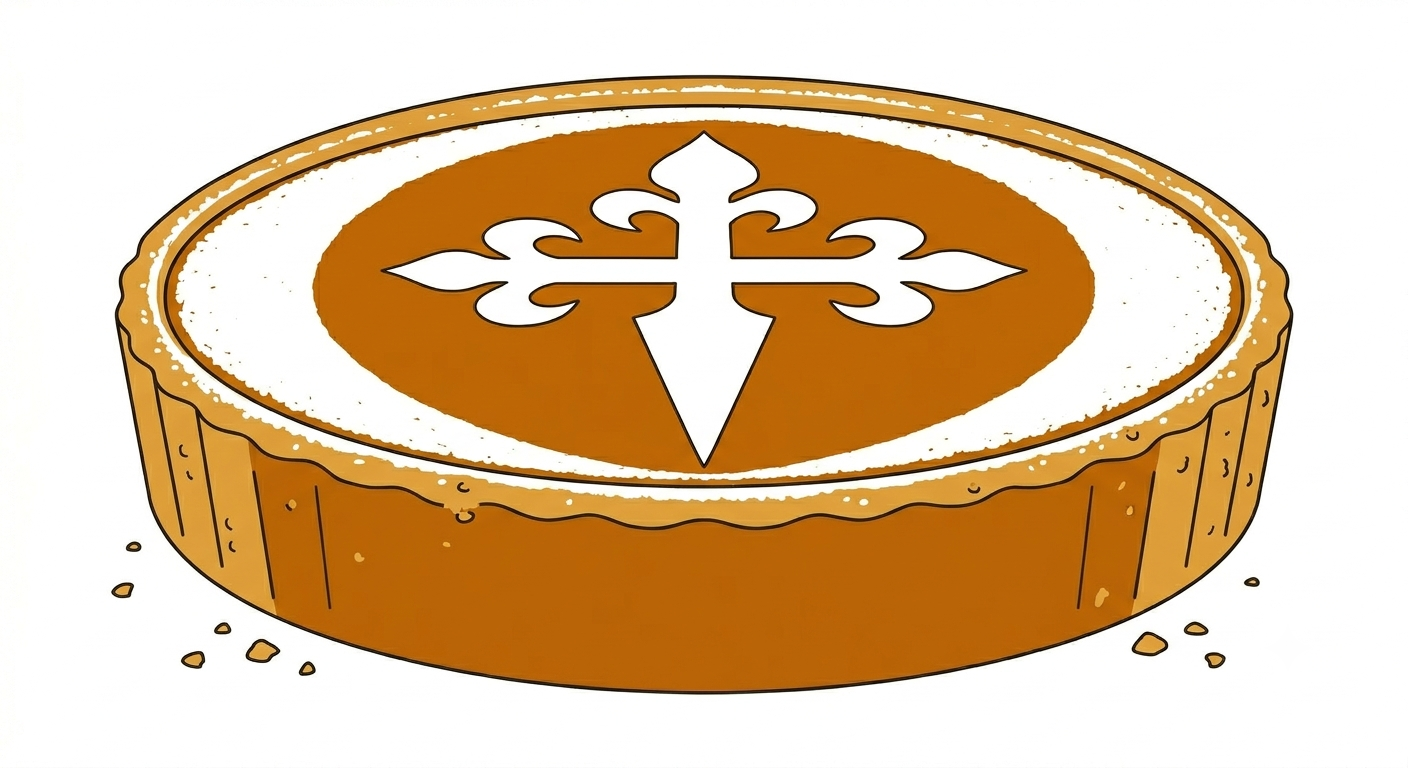
Tarta de Santiago is a flat, dense almond cake from Galicia in northwestern Spain, made from ground almonds, sugar, eggs, and lemon zest, with no flour and no butter. It is finished with a dusting of powdered sugar stenciled around the Cross of Saint James — the Cruz de Santiago — which is pressed into the top before serving, leaving the cross in relief against the white sugar. The cake is moist and slightly chewy, with a clean almond flavor and a faint citrus brightness that keeps it from being heavy despite its density. It is simple food made well, and it does not try to be anything else.
The cake is inseparable from the Camino de Santiago, the network of pilgrimage routes that converge on the Cathedral of Santiago de Compostela, where the remains of Saint James are said to be interred. Galicia has been a destination for Christian pilgrims since the 9th century, and the almond cake became associated with the city and the pilgrimage over centuries of travelers passing through. The first written reference to a cake resembling the modern tarta appears in a 1577 document recording the accounts of a local notary, though almond-based confections were common in the region well before that.
The Cross of Saint James stencil is the detail that ties the cake to its place most visibly, and in 2010 the Tarta de Santiago received Protected Geographical Indication status from the European Union, which means that to be sold under that name it must be produced in Galicia using a minimum of 33% almonds by weight. It is a meaningful protection for a cake whose identity is entirely bound up in its origin.
Almonds arrived in Iberia with the Moors, who cultivated them extensively across the peninsula from the 8th century onward. The influence of Moorish almond confections on Spanish and Portuguese baking is broad and well documented, and the Tarta de Santiago sits squarely within that tradition — a Christian pilgrimage cake built on an Islamic culinary foundation, which is the kind of layered history that makes Iberian food endlessly worth paying attention to.
This content was created with the assistance of AI. Sources are currently being reviewed.