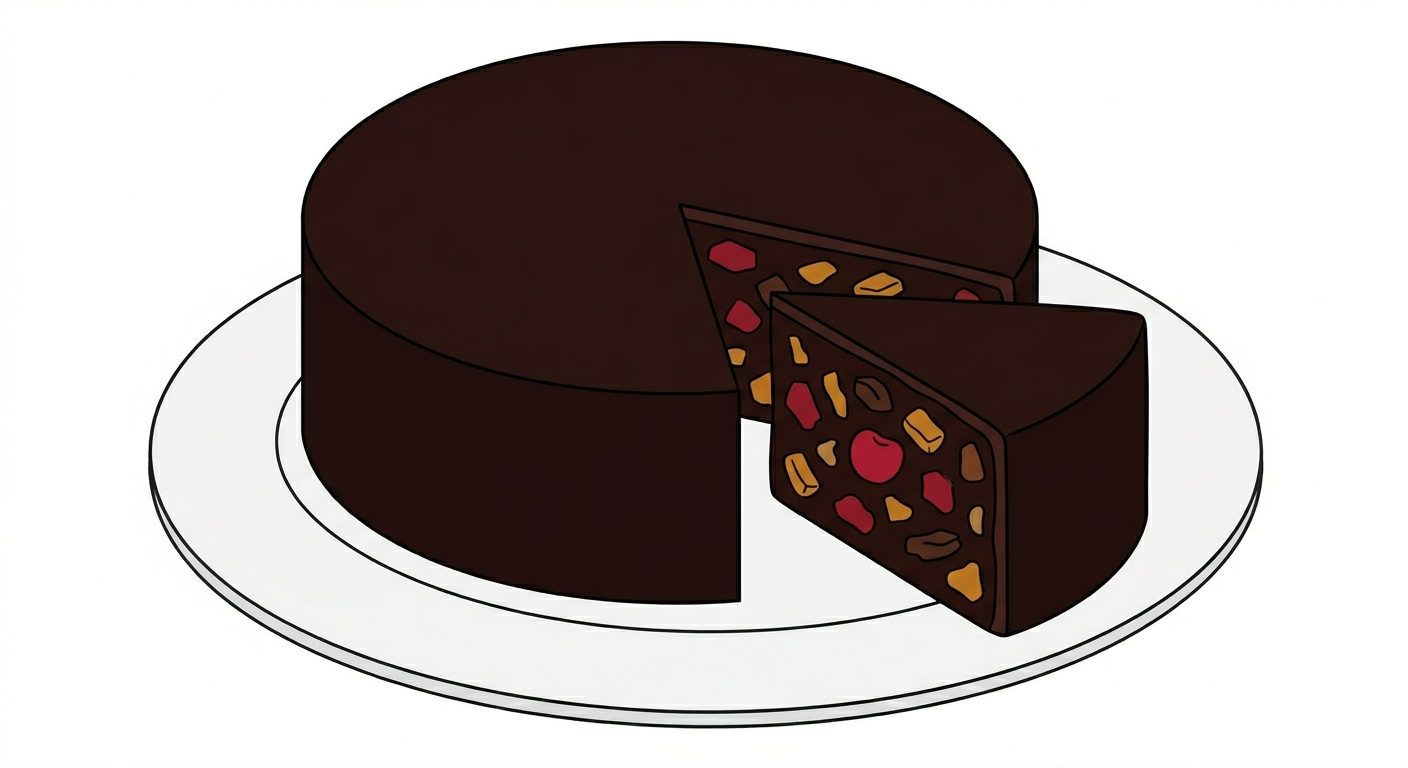
Torta Negra—known as Black Cake across the English-speaking Caribbean—is the regions most significant baked good, serving as the essential centerpiece of weddings and Christmas celebrations. Its lineage runs directly from British plum pudding and fruitcake, brought to the Caribbean by colonizers and transformed by enslaved African cooks who adapted the recipe using locally produced rum, available dried fruits, and the byproducts of the sugar industry. The British original became something categorically different in the process: darker, denser, and more intensely flavored.
The defining technique is the fruit soak. Prunes, raisins, currants, and cherries are submerged in a potent blend of dark rum, cherry brandy, and fortified wine—often Port or the iconic Red Label wine—for anywhere from one month to a full year. Over that time the fruit softens before being ground into a dense, dark paste. This grinding is the critical distinction; while British fruitcakes are chunky, a proper Torta Negra has a smooth, pudding-like consistency where no individual pieces of fruit remain identifiable. The length of the fruit soak is a matter of intense household pride across Trinidad, Jamaica, Guyana, and Venezuela.
The second defining technique is browning—a burnt sugar syrup made by cooking sugar until it blackens, then stopping the process with boiling water before it burns completely. Browning is stirred into the batter and gives the cake its near-black color and its characteristic bitter-edged depth. This is a specifically Caribbean technique with no equivalent in British baking, and it is what most clearly separates the cake from its colonial ancestor.
While it is the standard for weddings year-round, Torta Negra is primarily a communal Christmas food, made in large quantities and distributed through social networks. It is wrapped and given to neighbors, brought to workplaces, and sent to family abroad. In the Caribbean diaspora in New York, London, and Toronto, the cake arrives in December as a direct transmission of home—carried in luggage or shipped in tins, its high alcohol and sugar content making it uniquely suited for long-distance travel without refrigeration.
This content was created with the assistance of AI. Sources are currently being reviewed.