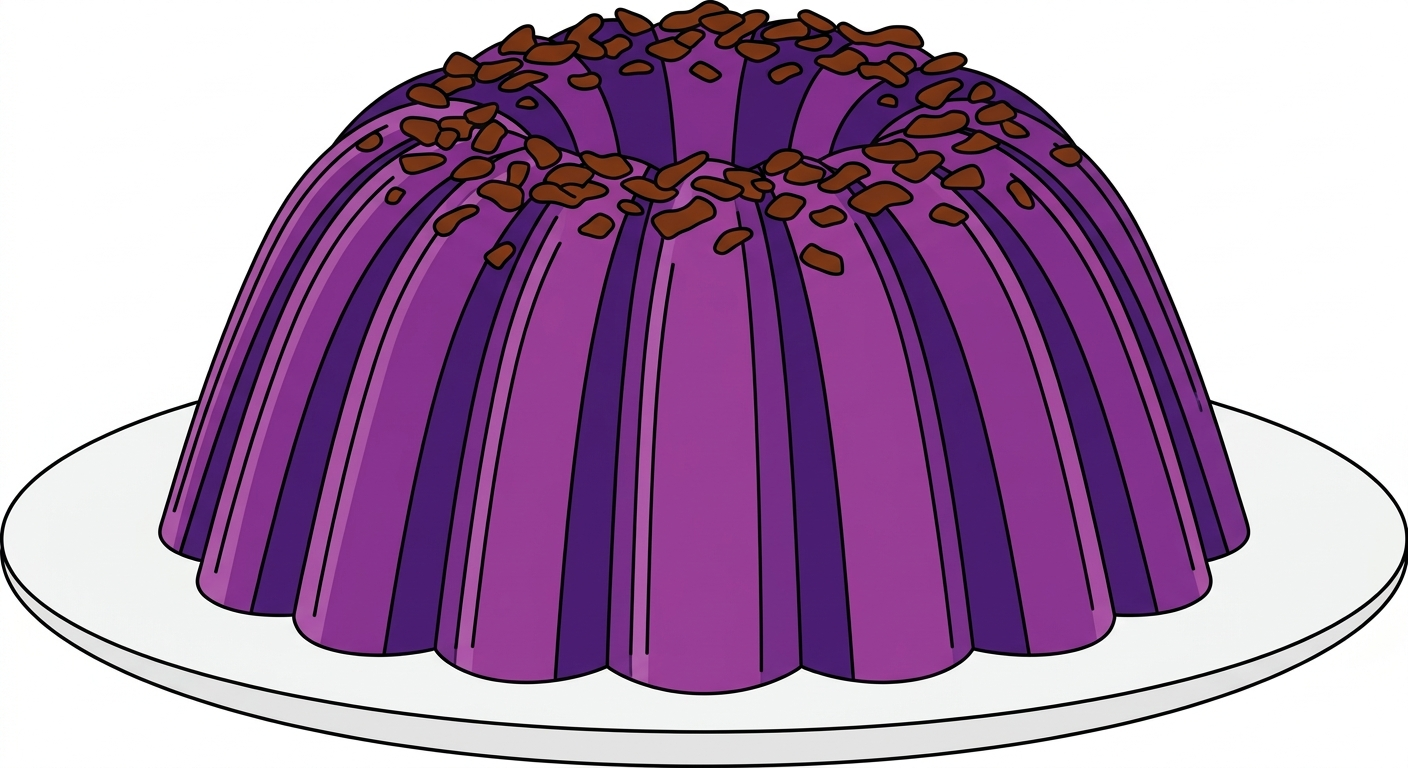
Ube halaya is a jam — grated purple yam cooked slowly with coconut milk, condensed milk, butter, and sugar, stirred continuously over low heat until the mixture thickens into a dense, smooth, deeply violet paste that holds its shape when scooped. The color is extraordinary — not the pale lavender of taro or the artificial purple of food coloring, but a vivid, saturated violet that intensifies as it cooks and remains when it cools. It is sweet, earthy, faintly nutty, with a starchiness that gives it body and a coconut richness that keeps it from being cloying. It is eaten on its own, spread on bread, scooped onto halo-halo, folded into ice cream, used as a filling for cakes and pastries, and given as a gift in jars at Christmas and celebrations. It is the dessert that most immediately communicates Filipino food culture to the outside world, which is a significant amount of cultural weight for a jam.
The ube — Dioscorea alata, the purple yam — is native to Southeast Asia and has been cultivated in the Philippines for thousands of years. Archaeological evidence places yam cultivation in the Philippine archipelago as far back as the prehistoric period, and ube is mentioned in the first Tagalog-Spanish dictionary published in 1613, placed there by Franciscan missionaries who were documenting local foodways. The plant is indigenous. The preparation that turned it into halaya is not — or at least not entirely.
The word halaya is a Filipino adaptation of the Spanish jalea, meaning jelly or jam. The Spanish colonial period, which ran from 1565 to 1898, introduced jam-making as a culinary technique across the Philippines alongside Spanish cooking methods and ingredients. Early Philippine cookbooks reference jalea de calabaza — pumpkin jam — as a preparation style that local cooks then applied to the ingredients they already had. Ube halaya is almost certainly a product of that contact: an indigenous ingredient transformed by a European preservation technique and renamed in the process. The 1918 Philippine cookbook contains a jalea de calabaza recipe but no ube halaya recipe yet — which places the formalization of ube halaya as we know it somewhere in the early 20th century, built on a Spanish culinary vocabulary applied to a pre-colonial ingredient.
What happened after is the story of a preparation finding its full identity. Condensed milk — introduced through American colonial contact in the early 20th century — joined coconut milk as a standard ingredient and gave ube halaya the particular richness and sweetness that defines the contemporary version. The slow-stirring method, which requires anywhere from thirty minutes to over an hour of continuous attention over heat, became the technique through which ube halaya was understood as an expression of care — the kind of thing made for special occasions and given to people who matter, the labor visible in the result.
The global visibility of ube halaya arrived through the Filipino diaspora and accelerated dramatically in the 2010s when its color made it ideal for social media. The vivid purple photographs exceptionally well, and once American food media discovered ube in Filipino-American bakeries and restaurants, the ingredient and its most iconic preparation traveled quickly into mainstream consciousness. Ube pancakes, ube lattes, ube donuts, ube cheesecake — all of these rest on ube halaya as their base, the jam that gives everything else its flavor and its color. The ingredient is thousands of years old. The fame is recent. The halaya connects the two.
This content was created with the assistance of AI. Sources are currently being reviewed.