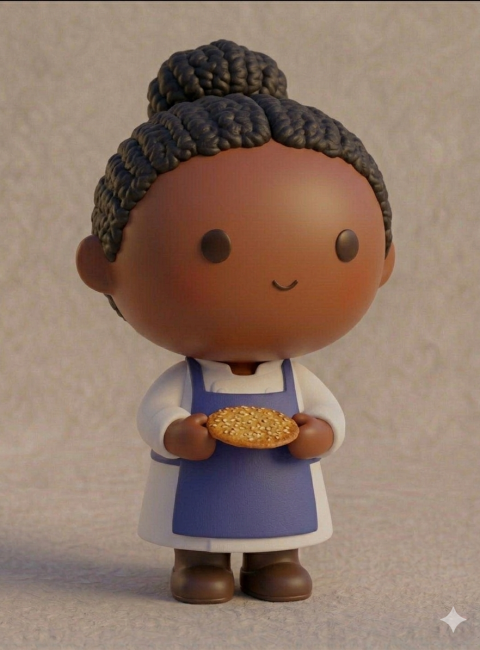
Madame Amina Benne grew up in the Sea Islands of the South Carolina Lowcountry where benne wafers were not a specialty item — they were simply part of the kitchen. Benne seeds arrived in the United States with African ancestors, and were cultivated by enslaved people in their own gardens on the Sea Islands. By the time Amina was learning to bake, benne wafers were woven into the fabric of Gullah Geechee food culture — made for holidays, shared at gatherings, passed down through demonstration rather than written recipe.
Her work centers on Gullah Geechee sweet tradition — benne wafers made thin and crisp the way they are meant to be, sweet potato pone baked slow until it sets with that dense, spiced sweetness, and chewies made with molasses and pecans for celebrations. The Gullah Geechee people introduced benne, okra, and peanuts to their new home, and through farming taught plantation owners how to grow rice — a history of agricultural knowledge and cultural preservation that Amina carries forward in every recipe she makes.
In Universo da Doçura, Madame Amina represents a food tradition that is one of the most historically significant and culturally distinct in the American South. The Gullah Geechee people are the descendants of West and Central Africans who were enslaved and brought to the coastal regions of South Carolina, Georgia, and northeastern Florida, and their food culture has survived through the active work of preservation across generations. Her benne wafers are always thin. Her sweet potato pone is always made from scratch.
This content was created with the assistance of AI. Sources are currently being reviewed.