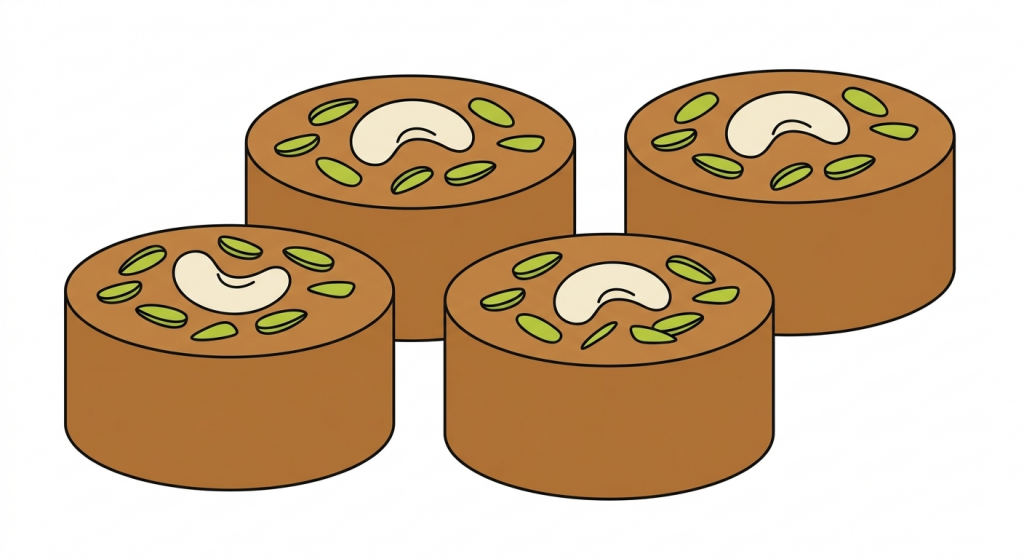
Punjab’s dessert tradition is built on abundance — ghee, whole milk, wheat, jaggery, and nuts used generously in preparations that reflect the agricultural wealth of one of South Asia’s most productive farming regions. The Punjab region spans the Indian states of Punjab and Haryana and the Pakistani province of Punjab, and the sweet traditions on both sides of the 1947 Partition border share common roots while having developed separately over the past eight decades.
Pinni is one of the most distinctly Punjabi sweets — a dense ball made from whole wheat flour roasted in ghee, mixed with jaggery, nuts, and dried fruit. It is eaten in winter as an energy-dense food, traditionally prepared by women in large batches at home and stored for weeks. Pinni reflects the Punjabi approach to sweetness as sustenance — substantial, calorie-dense, and built for cold weather and physical labor. Gajar ka halwa — carrot halwa — is made by slow-cooking grated carrots in milk and ghee until reduced and sweetened, associated with winter when red Delhi carrots are in season and considered a pan-North Indian preparation that is particularly well-developed in Punjab.
The Sikh langar tradition — the communal kitchen operated at every Gurdwara that provides free meals to anyone regardless of religion, caste, or background — includes sweet preparations as part of the meal. Karah prasad is a semolina, ghee, and sugar halwa prepared in equal proportions of all three ingredients, blessed and distributed to every person who enters a Gurdwara. It is one of the most widely consumed ritual foods in the world given the scale of Gurdwara attendance globally, and its preparation follows a specific protocol that has remained consistent across the Sikh diaspora.
The 1947 Partition of British India divided Punjab between India and Pakistan, displacing millions of Punjabis on both sides of the new border. Punjabi Hindu and Sikh families who moved to Delhi, Amritsar, and other Indian cities brought their food traditions with them, and many of the mithai shops established in Delhi in the late 1940s and 1950s were founded by Partition refugees from what became Pakistani Punjab. This migration directly shaped the sweet culture of Delhi and is why certain Punjabi preparations are now considered standard North Indian sweets.
This content was created with the assistance of AI. Sources are currently being reviewed.