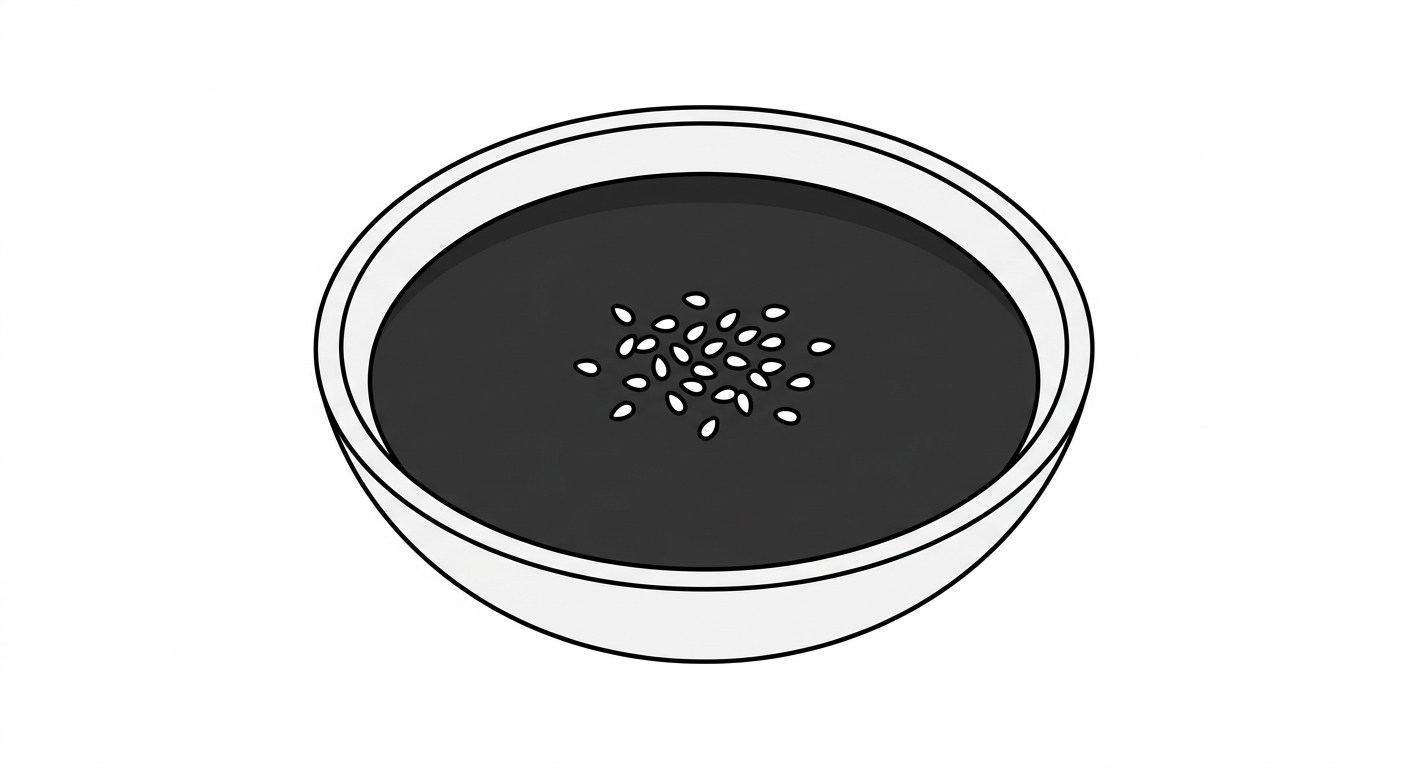
Black sesame soup is exactly what the name describes — black sesame seeds toasted until fragrant, ground fine with soaked glutinous rice and water, simmered until the mixture thickens into a smooth, glossy, deeply dark paste-like soup, sweetened with rock sugar. The color is an intense, matte black that looks more pigment than food. The flavor is nutty and slightly bitter at the edges, with a depth that comes from the toasting and a richness that comes from the sesame’s natural oils. It is served warm, in a small bowl, and eaten slowly. It is winter food, comfort food, the kind of thing that feels like it is doing something for you while you eat it — which, in Traditional Chinese Medicine, it is.
Black sesame — heizhima — has been documented in Chinese herbal pharmacology since approximately 100–200 CE, appearing in the Shennong Bencao Jing, one of the foundational texts of Chinese medicine. It is classified as a superior herb with tonic properties, understood to nourish the kidneys and liver, replenish vital essence, and darken hair — the last claim being the one most frequently mentioned by grandmothers across southern China, who have been recommending black sesame soup to people with white hair for centuries with varying degrees of success. The soup sits at the intersection of dessert and medicine in a way that is entirely natural in Chinese food culture, where the line between what tastes good and what is good for you is deliberately blurred.
The soup belongs to the tong sui tradition — the Cantonese category of sweet soups that function as dessert, snack, and restorative simultaneously. Tong sui means sugar water in Cantonese, which is both modest and accurate: the category includes everything from red bean soup to almond paste to grass jelly, all of them sweet, all of them served at the end of a meal or between meals, all of them associated with the Pearl River Delta’s sugarcane abundance and the Cantonese habit of eating for health as much as for pleasure. Black sesame soup is one of the oldest entries in that category, present in Guangzhou tong sui shops from the early 20th century alongside mung bean soup and almond soup as one of the foundational offerings.
In practice, the quality of black sesame soup depends almost entirely on the sesame. The seeds must be fully toasted — insufficiently toasted sesame produces a flat, raw-tasting soup — and ground fine enough that the finished texture is smooth rather than gritty. The glutinous rice thickens the soup naturally as it cooks, binding the ground sesame into a cohesive paste that holds its consistency in the bowl rather than separating. Tangyuan — small glutinous rice balls, often with black sesame filling — are sometimes added, making the soup simultaneously the wrapper and the filling of the same ingredient, which is the kind of recursive logic that only makes sense in a food culture that thinks about these things carefully.
The soup traveled with Cantonese migrants across Southeast Asia — to Vietnam’s Hoi An, where it is called xí mà and has been made by the same family for nearly a century — and to Hong Kong, Taiwan, Singapore, and Malaysia, where it appears in dim sum restaurants, tong sui shops, and home kitchens as one of the most consistent expressions of southern Chinese dessert culture.
This content was created with the assistance of AI. Sources are currently being reviewed.