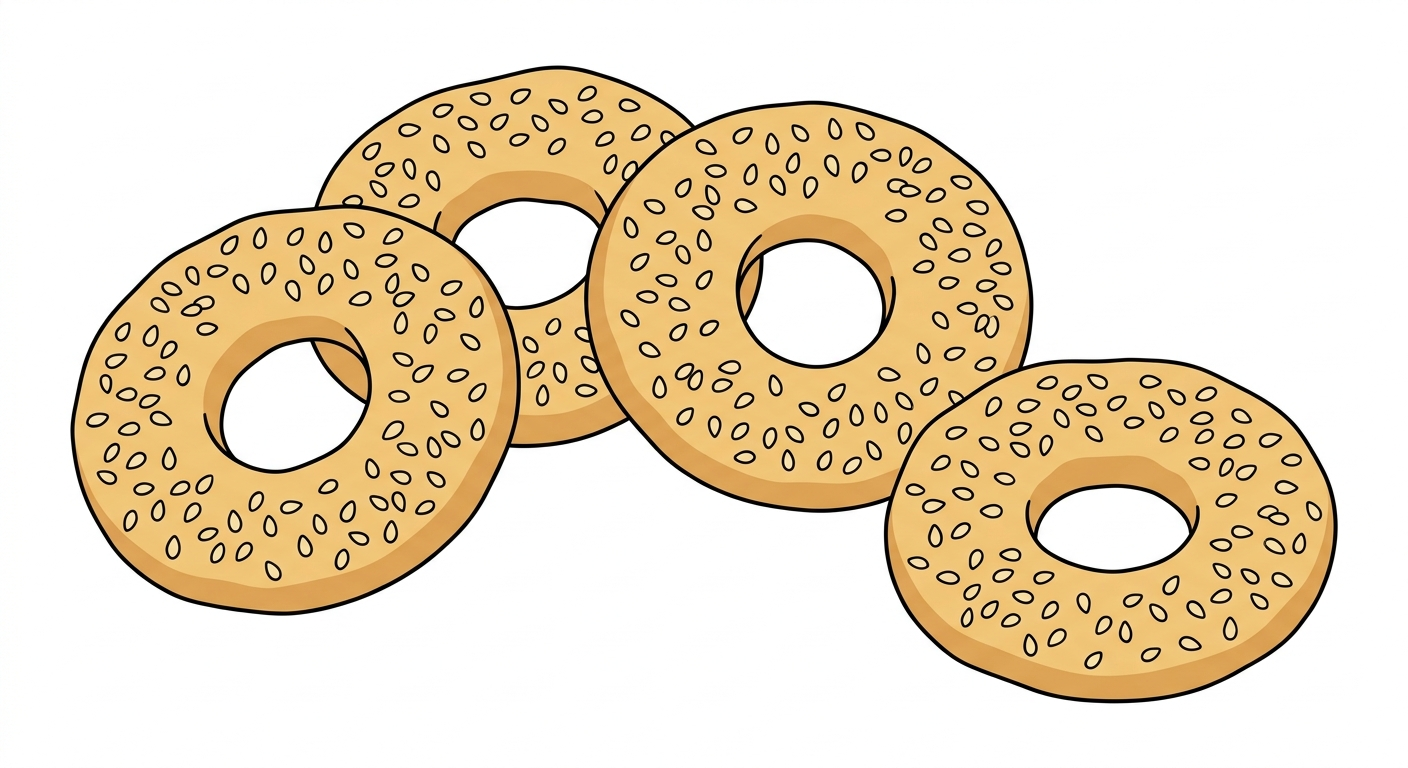
Biscochos are Sephardi Jewish ring-shaped cookies made from a simple dough of flour, oil, eggs, and sugar, flavored with anise or sesame, rolled into thin ropes and shaped into small circles, dipped in sesame seeds, and baked until firm and dry throughout. They are not soft cookies — they are meant to be crisp, slightly hard, and long-lasting, the kind of thing you dip into coffee or tea to soften slightly before eating. The sesame coating toasts in the oven, adding a nutty fragrance and a faint bitterness that offsets the mild sweetness of the dough. They are unassuming in appearance and deeply satisfying in the way that only very simple, very well-made things can be.
The name comes directly from the Spanish bizcocho — itself derived from the Latin bis coctus, meaning twice-cooked — the same root that gives us the French biscuit and the Italian biscotto. The Sephardi biscocho preserved the medieval Iberian form of the word in Ladino while the Spanish language moved on, which makes the cookie a small linguistic artifact as much as a culinary one. The twice-baked technique that the name originally described — baking once to cook the dough, then again to dry it completely — produced a cookie that could last for weeks without spoiling, a practical consideration for a community that needed food that could travel and keep through long journeys and uncertain circumstances.
Biscochos are Shabbat cookies in the most fundamental sense — made on Friday, kept through the week, eaten at any moment when something small and sweet is wanted alongside a cup of coffee or tea. They are not holiday-specific in the way that many Sephardi sweets are, though they appear on holiday tables as part of the broader spread of small cookies and pastries that marks celebrations in Sephardi homes. Their everyday quality is part of their identity — they are the cookie that is always there, always available, always exactly what they are supposed to be.
The communities most associated with biscochos are those of the former Ottoman Sephardi world — Turkey, Greece, Bulgaria, and the broader Balkan diaspora — as well as Sephardi communities in the Americas, where the cookie traveled with 20th-century immigration and became a staple of Sephardi home baking in cities like New York, Seattle, and São Paulo. In Seattle, home to one of the largest Sephardi communities in the United States, biscochos remain a living tradition — made at home, shared between families, and sold at synagogue bake sales with the kind of quiet continuity that marks a food that has genuinely survived.
This content was created with the assistance of AI. Sources are currently being reviewed.